
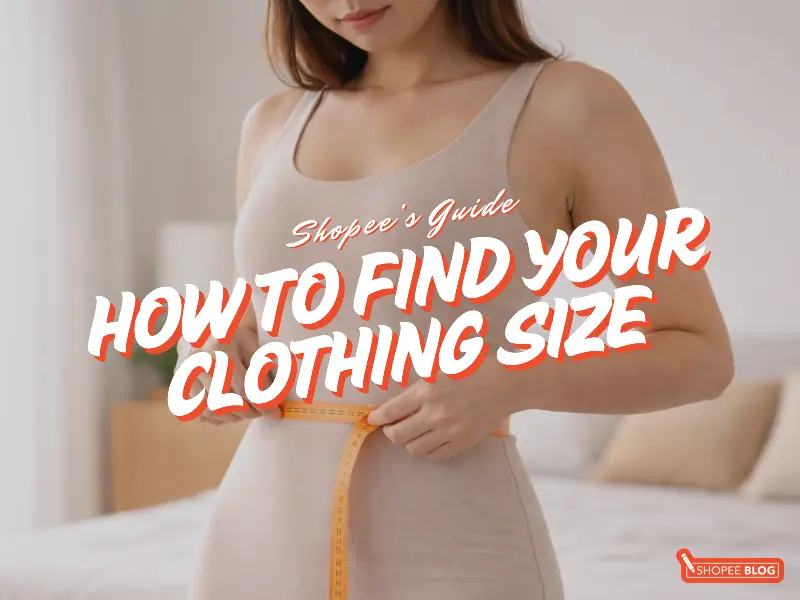
Ever ordered clothes online only to end up with the wrong size? As someone who buys clothes online all the time, I know that frustration. You just want to get some nice clothes from Shopee, but the fit is always off. Well, it took a few returns and disappointments for me to realise that the secret to online shopping success is knowing how to take measurements for clothes properly.
If you’ve rarely shopped online due to sizing concerns, don’t worry. With a few of my measurement tips – from bust to hips – you’ll have all you need to find pieces that fit just right
How to make sure you get the right size when you shop online?
Shopping for clothes online doesn’t have to be a guessing game. Here are some tips on making sure you get the right size when buying clothes on the internet:
Always check the size chart and product measurements
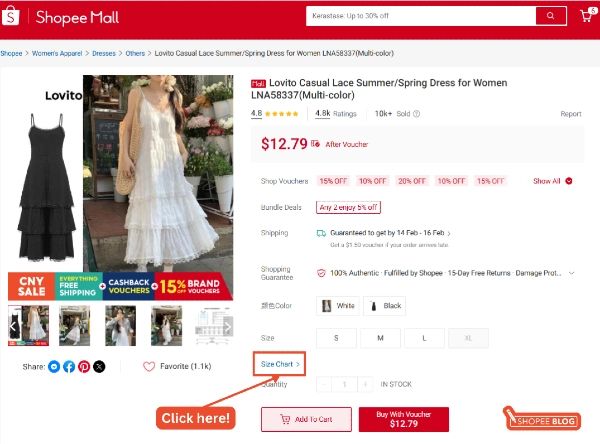
Never skip the sizing information provided by the different Shopee sellers. There’s usually a Size Chart on the product listing, whether it’s in the photo gallery, via a clickable link, or even in the product description below.
Compare the clothing’s measurements (like chest width or dress length) to your own body measurements. This will give you a much better idea of fit than simply trusting labels like “M” or “L”. Each brand can size differently, so you must let the tape measure guide you.
Pay attention to fit descriptions (slim, relaxed, oversized)
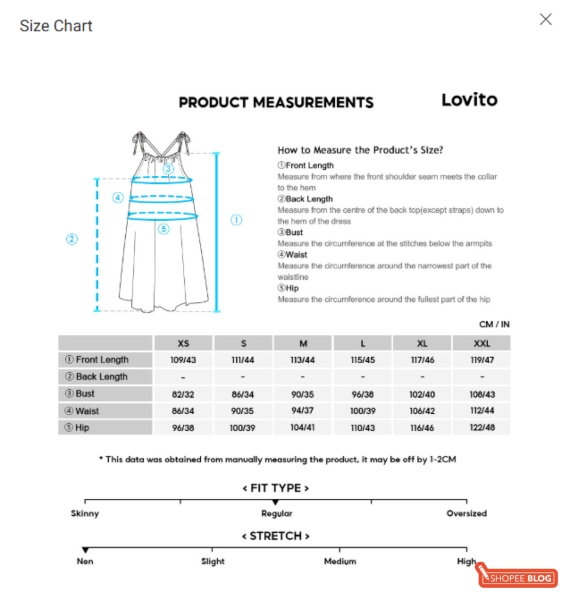
Many product listings will tell you if a piece runs tight or loose. For example, relaxed fit or oversized means the garment is meant to fit loosely. You can consider sizing down as well if you prefer a more fitted look. Slim fit means it’s cut closer to the body, so you’ll have to size up if you don’t want it too snug. If something is described as “true to size,” it should fit as per the size chart, but it’s still best to double-check the measurements.
Look at model info and read reviews
Often, online sellers would include the model’s height and the size they’re wearing. This info may be within the product’s description section, so you may have to scroll down a little. But this can give you a clue about how long or baggy the item is.
Even better, scroll through customer reviews. Reviewers would typically mention if an item runs small or large, or if the cut is good for certain body types. And since reviews are tagged to their purchases, you’d be able to get a better picture on what size you should get!
Don’t assume your usual size always works
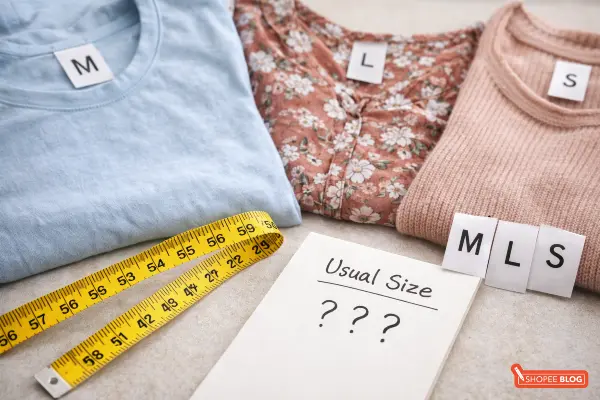
A common mistake is ordering the same size you always wear without considering the brand’s sizing differences. A “Medium” in one brand might fit like a Small or Large in another. Sizes vary across brands and countries, so rely on measurements, not just size labels. If you’re between sizes on a chart, it’s often safer to choose the larger size. You can always tailor something slightly looser, but you can’t magically add fabric to something too small.
Know your own measurements
Using a measuring tape, record your key body measurements – especially your bust, waist, and hips. Having these numbers handy means you can immediately compare them to any size chart and pick the closest match. Also, note your other measurements if relevant, such as inseam (for trousers) or shoulder width, depending on what you’re buying. The more you know about your body, the easier it is to find clothes that fit well.
Keep an updated “measurements cheat sheet”
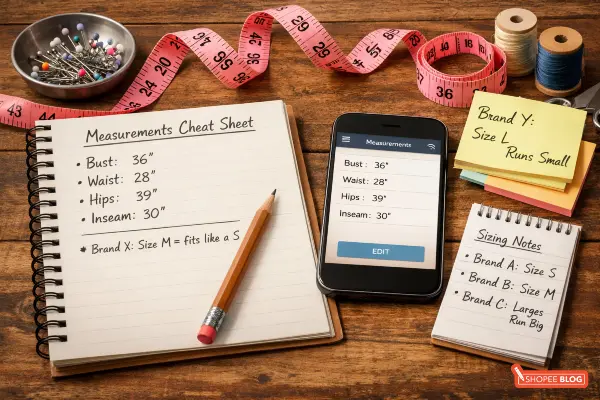
Our bodies can change over time, so it’s a good idea to remeasure every few months and update your notes. Jot down your current measurements in a notebook or on your phone for quick reference. Also, keep track of any brands that consistently run large or small for you (e.g. “Brand X’s size M fits more like a S on me”). This way, you’ll remember if you usually need to size up or down for a particular label. Keeping your measurements up to date and knowing how different brands fit you will save you a lot of hassle in the future.
Body measurement guide: How to measure bust, waist size, and hip size
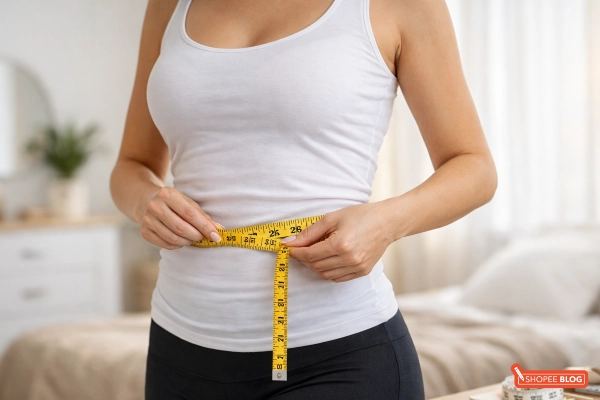
Before you grab that cute dress online, grab a measuring tape! It’s best to use a flexible tailor’s tape for measuring your body. For consistency, wear minimal or form-fitting clothing, or just your undergarments, when measuring. Bulky clothes can add extra inches you don’t want. Stand up straight, breathe normally, and don’t suck in your tummy – you want real measurements, not wishful thinking.
How to measure your bust size
Measure around the fullest part of your bust. Wrap the tape measure around your back and under your arms, so it goes across the fullest part of your chest. The tape should be level across your back and not droop down or ride up. Make sure it’s snug but not too tight – you should be able to breathe comfortably. This bust measurement will correspond to the “bust” or “chest” on size charts.
How to measure your waist
Measure your natural waist, which is usually the narrowest part of your torso. It’s roughly above your belly button and below your ribcage. Keep the tape measure flat around your waist. It should be against your body but not cinching you in tightly. A good guide is to leave a finger between your body and the tape so it’s not too tight.
How to measure your hips
Measure around the widest part of your lower body. This is typically around your hips and buttocks at the fullest point. Stand with your feet together, and wrap the tape around the circumference of your hips, making sure it stays level (parallel to the floor). For many, the fullest point of the hips is about 21-23 cm (8-9 inches) down from the natural waist, but it can vary. Just make sure you find the widest area, keep the tape comfortably snug, and you’ll get your hip measurements.
Pro tip: If you don’t have a flexible measuring tape, you can use a piece of string or ribbon. Mark the point where the string overlaps, then measure that length against a ruler. Also, measure yourself twice for each area (to double-check) and use a mirror to ensure the tape isn’t twisted or slanting down in the back.
How to measure PTP on body?
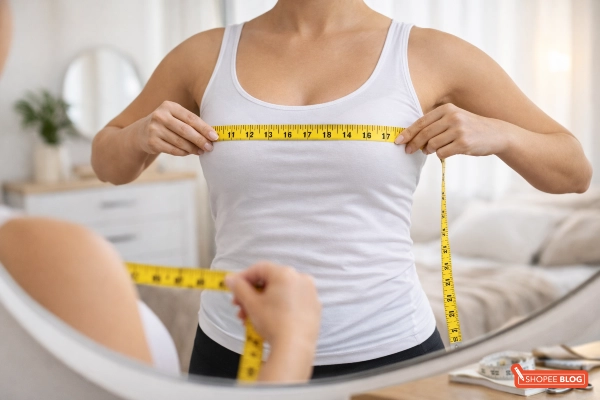
PTP stands for “pit-to-pit,” a common measurement for tops. Pit-to-pit is basically the width of a garment across the chest, from one armpit (pit) to the other when laid flat. It’s essentially half of the chest circumference of the shirt or dress. But how do you measure PTP on your body?
- Stand in front of a mirror and hold a measuring tape across the front of your chest at armpit level (right under your underarms).
- Measure straight across from one armpit to the other.
This gives you an approximate pit-to-pit measurement of your body (it’s roughly half your bust circumference). For example, if your body’s pit-to-pit measures around 54 cm (that’s about 21 inches), your full bust circumference is roughly 108 cm (around 42 inches) when doubled. In terms of fit, a shirt with a 54 cm (21″) PTP would be very snug on a 108 cm (42″) chest – basically no allowance – whereas that same shirt would feel a bit loose on a 102 cm (40″) chest. In general, you want a garment’s PTP to be a few centimetres (an inch or two) more than your own half-chest measurement for comfort.
If that’s confusing, another easy method is to take a shirt that fits you well and measure its pit-to-pit directly. Lay it flat and measure straight across between the bottom of one armhole to the other. Then, you can compare that number to online product measurements. By knowing your own PTP (or your favourite shirt’s PTP), you can better judge if an online top will fit you in the chest.
What are some common measurement mistakes?
Taking your own measurements isn’t hard, but there are some common mistakes that can throw off the numbers.
Measuring yourself over bulky clothing
If you measure while wearing a sweater, jacket, or even a thick shirt, you’re going to get a larger number than your body actually is. This seems obvious, but even a regular T-shirt or jeans can add a bit of width. The best practice is to measure over very thin clothing or just your underwear. For example, measure your waist over a thin tank top or directly on your skin – not over a chunky belt or hoodie. This ensures you’re not accidentally adding extra centimetres to your body measurements.
Pulling the tape too tight (or too loose)
Accuracy is all about tension. Yanking the tape measure so tight that it digs into your skin will give you a number that’s smaller than your body actually is. On the other hand, holding it too loosely can overshoot the measurement. You want the tape snug against you, but not squeezing. A good rule of thumb: you should be able to slide one finger between your body and the tape comfortably. If you can’t, it’s probably too tight. If there’s a lot of slack, it’s too loose. Keep it consistent – taut but not pinching.
Mixing up the units or misreading the tape
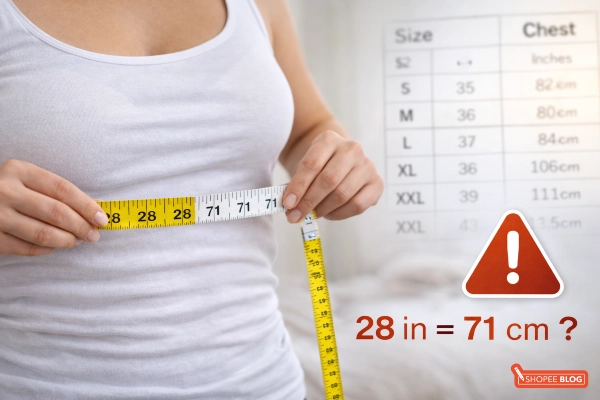
Many measuring tapes have centimetres on one side and inches on the other. If a size chart is in inches and you accidentally look at the cm side (or vice versa), you’ll get a wildly incorrect size. For instance, 28 inches is about 71 cm – confusing these could ruin your online order.
Also, start the measurement at “0” on the tape, not at the metal tip. Ensuring the tape is flat and not buckling will help you read it correctly, too. If the numbers are hard to see, get good lighting or even take a photo of the tape wrapped around you, then look at the photo to read the number.
Not keeping the tape level and straight
This is a subtle mistake that can happen, especially for areas like the bust and hips. If the tape droops at the back or isn’t straight, you’ll get the wrong reading. Imagine the tape forming a crooked line instead of a perfect circle around you – that can add or subtract centimetres. To avoid this, always keep the tape parallel to the floor around your chest, waist, and hips. Use a mirror to check, or ask someone to help ensure it’s level around your back. Also, make sure the tape isn’t twisted. A bent or twisted tape can throw off the measurement and be hard to read accurately.
Bad posture or holding your breath while measuring
Stand normally when you measure – don’t puff out your chest, suck in your stomach, or slouch. If you hold your breath and suck in your tummy, your waist measurement will be unrealistically small (and that garment may strangle you when you actually wear it!). And don’t push your stomach out either. Just relax and breathe as usual. Likewise, stand up straight but comfortably.
Slouching can make some measurements larger (for example, if you hunch, your bust or shoulder width might read wider). The goal is a neutral, everyday posture for true-to-life numbers.
Pro tip: If you tend to tense up, take a couple of normal breaths and measure on an exhale – but don’t hold your breath. Consistency is more important than achieving a mythical “perfect” posture.
How to take measurements for clothes and shop with confidence
By now, you know how to take measurements for clothes and use them to find your perfect size. With your trusty measuring tape and these tips, shopping online can be as rewarding as shopping in person – minus the fitting room queues! For more inspiration on what to do with your well-fitted wardrobe, check out our Styled by Shopee series for the latest outfit ideas and styling tips. And if you’ve cleared out clothes that no longer fit, you might want to turn them into cash or make space for new pieces – find out where to sell used clothes in Singapore and give your pre-loved outfits a second life.